
IS PUERTO VALLARTA SAFE?
| Weather & Climate | Hurricane Central | Swine Flu 2009 | Relief Agencies | FAQ |
The #1 place in
Puerto Vallarta for up-to-date safety information and coverage.
|
Everyone by now has heard the so-called drug war that has been taking place in Mexico for several years now. While the vast majority of this violence has happened in a narrow swath right along the US-Mexico border, affecting only a tiny fraction of Mexico, it has been widely reported that Mexico is dangerous by cable news and the blogosphere. Every crime, big or small, throughout the world's 14th largest and 11th most populated country is propagated as a reason to fear Mexico, regardless of how it affects you as a tourist. |
Is Puerto Vallarta Safe? |
You can find statements on both sides made to support their theories about safety in Mexico, but most are skewed and many are blatantly false. Unlike those statements, all of our information is cited from reliable sources, mostly government agencies in the U.S. and Canada.
CUT THROUGH THE HYPE
Q:
WHAT IS THIS DRUG WAR I KEEP HEARING ABOUT?
A: Since
President Calderon was elected in 2006, the Mexican
government has been cracking down on the drug cartels
that have always existed in Mexico in an effort to stomp
out drug trafficking to the United States. As the
government arrests or kills cartel leaders, various
battles for turf between the cartels to fill the void
have opened up. Over 90% of the deaths in the drug
war have been from members of the drug trade
1. 7% have been the Mexican government.
2 None have involved U.S.
or Canadian tourists in any of the major resort
destinations in Mexico, including Puerto Vallarta.
3
Q:
SHOULD I WORRY ABOUT DRUG CARTEL VIOLENCE IN PUERTO
VALLARTA?
A: There are
zero U.S. or Canadian citizens who have been
victims of drug cartel violence in Puerto Vallarta.1
The vast majority of the stories you have been hearing
about are taking place right along the U.S.-Mexico
border, most notably in the areas of Ciudad Juarez,
Nuevo Loredo and Heroica Nogales, far closer to most
Americans homes than to Puerto Vallarta, which lies over
1,000 miles to the south. Mexico is a big country,
the 14th largest in the world. Being spooked by
something happening "in Mexico" makes no more sense than
reading something happened somewhere "in the United
States" and fearing for your life as you go to work that
day. You have to see where in Mexico it happened
to see if it is relevant to you. See the table
below.
|
HOW CLOSE IS
PUERTO VALLARTA TO THE MAIN TROUBLE SPOTS? HOW CLOSE IS YOUR CITY? |
|
Distance from Puerto Vallarta
to Juarez: 1,080 Miles (1,738 km) Distance from Puerto Vallarta to Tijuana: 1,362 Miles (2,192 km) Distance from Canadian Border to Tijuana: 1,382 Miles (2,223 km) Distance from San Diego, CA to Tijuana: 17 Miles (27 km) Distance from Tucson, AZ to Nogales: 70 Miles (113 km) Source: Google Maps |
Q:
BUT DIDN'T THE U.S. JUST
ISSUE A TRAVEL WARNING FOR PUERTO VALLARTA?
A:
No. The
travel warning dated February 8, 2012 includes only
the areas bordering the states of Michoacan and
Zacatecas, which are over 300 miles from Puerto
Vallarta.
Regarding the neighboring state of Nayarit where Nuevo
Vallarta, Bucerias and Punta Mita are located, it
specifically states ""There is no recommendation
against travel either to Riviera Nayarit in the southern
portion of [Nayarit] state or to principal highways in
the southern portion of the state used to travel from
Guadalajara to Puerto Vallarta".
See a map of the areas discussed by the U.S. State
Department here:
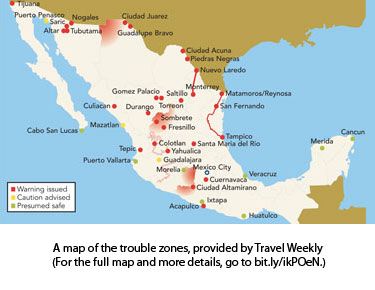
You will note that Puerto Vallarta has a green dot, as
do the other major resorts of Cabo San Lucas, Huatulco
and Cancun, indicating "Presumed Safe".
See the article here. In addition,
seldom-quoted parts of the travel warning include:
"Millions of U.S. citizens safely visit Mexico each year for study, tourism, and business, including more than 150,000 who cross the border every day. The Mexican government makes a considerable effort to protect U.S. citizens and other visitors to major tourist destinations, and there is no evidence that Transnational Criminal Organizations (TCOs) have targeted U.S. visitors and residents based on their nationality. Resort areas and tourist destinations in Mexico generally do not see the levels of drug-related violence and crime reported in the border region and in areas along major trafficking routes.".
Q: BUT
I'VE HEARD THAT U.S. AND CANADIAN CITIZENS HAVE BEEN
KILLED?
A: Exactly
zero U.S. or Canadian Citizens were killed in Puerto
Vallarta in all of 2010, out of the 1.5 million visiting
tourists and 50,000 expats living here. See the
table below.
| MURDERS IN PUERTO VALLARTA (2010) |
|
Foreign Tourists that Visited
Puerto Vallarta: 1,482,222
4 |
In fact, in 2010, there were exactly 2 U.S. Citizens killed in all of the major tourist destinations in Mexico put together - one in Cancun (by her American husband) 1,2 and one outside of Acapulco (a resident, by the military) 3. A grand total of zero for Riviera Maya, Puerto Vallarta, Mazatlan, Cabo San Lucas and Cozumel combined.4 Zero homicides committed against a tourist by a Mexican in any major Mexican resort town in all of 2010 out of approximately 6 million visitors every year to these locations. It just doesn't get safer than that. Compare your hometown's homicide statistics here.
In June, 2011, the blogosphere erupted because a Canadian citizen who had lived in Puerto Vallarta full-time for six years (not a tourist), was killed during a home burglary by someone he apparently knew 4. The intruder made off with over $20,000 in cash. Over 600 Canadians each year suffer a similar fate...in Canada. This is the lone incident in Puerto Vallarta against any U.S. or Canadian citizen in 2011, and it was not a tourist.
Q: BUT
WHAT ABOUT THAT ROBBERY OF CRUISE PASSENGERS THAT IS ALL
OVER THE NEWS AND BLOGS?
A: In
February, 2012, the media again erupted with wall to
wall coverage of reports of armed gangs robbing cruise
passengers in the city of Puerto Vallarta.
However, like many of today's media reports, these later
were revealed to be inaccurate. It was quickly revealed
that a group of cruise passengers on a cruise-sponsored
jungle tour were walking on an unauthorized side trail
through the jungle well outside of the city at 5:00 PM,
well past the time when these excursions are supposed to
run, when a lone gunman (not a gang) mugged them. Nobody
was hurt, all passengers returned safely, and the cruise
line has dropped the excursion during the investigation.
This isolated incident is the first such group mugging of tourists on record in Puerto Vallarta - ever. In fact, it appears to be the first such incident on record in any of the port cities in Mexico, the world's most visited cruise destination, ever. The same cannot be said for other popular cruise destinations, including St. Kitts 9, Antigua 10, Jamaica 11, The Bahamas 12 13 14, St. Lucia 15, Guatemala 16, Costa Rica 17, Italy 18, Bermuda 19, and yes, the United States 21 22 and it's territories, 23 all of which have experienced violent crime against cruise passengers in recent years. Of course, virtually all crime against cruise passengers still occurs on the cruise ship itself, not in any port city.
That said, travel in general is very safe, and incredibly safe for visitors to the tourist resorts and port cities of Mexico. Crime against tourists is staggeringly rare. These isolated reports are blown into countrywide epidemics if they occur in Mexico, one of the world's largest countries, but the statistics speak a very different story. 22 Million Visitors to Mexico every year, including approximately 2 million to Puerto Vallarta. Think how many crimes would occur in any American city of that size in a year. Hundreds of Thousands, or even Millions. Staggeringly rare. That is why it is almost impossible to find any visitor to Puerto Vallarta who feels anything but safe when visiting here.
In the USA, there were 367,832 robberies in 2010 alone. 24
Q:
THEN WHY ARE CRUISE SHIPS PULLING OUT OF PUERTO
VALLARTA?
A:
Economics. Cruise ships have cited "the
perception"
1 of violence in Mexico as one of the reasons
for bookings on their Mexican Riviera cruises being down
21%
2 over the past two years. Don't take
our word for it - here are the actual reasons cited by
the cruise lines for their decisions to leave the
Mexican Riviera cruise route - not from ranting blogs or
forums or flashy newspaper or cable TV headlines, but
direct quotes from top officials at the cruise lines
themselves:
Royal
Caribbean Cruise Lines
"We're looking to
maximize our profits, said
Harrison Liu, a spokesman for the
cruise line, owned by Miami-based
Royal Caribbean Cruises Ltd. Both
Europe and the Caribbean are hotter
tickets than the Mexican Riviera,
and theres a stable market out of
Galveston. In a blog
addressing the issue, company Chief
Executive Adam Goldstein explained
further. There is no question that
there are tens of thousands of loyal
Royal Caribbean cruisers who live in
the Western U.S. and cruise on
Mariner of the Seas, Goldstein
wrote. Yet the ship does not
perform at an acceptable level to be
able to remain in California.
Carnival
Cruise Lines
Since Carnival Cruise Lines
announced the move of the Carnival
Spirit to Australia, the story has
been painted that the line is
abandoning the West Coast, but that
is not the reality, according to
Terry Thornton, senior vice
president of marketing planning.
We have right-sized our capacity on
the West Coast due to less than the
best economic results,
he explained. However, Carnival will
continue to have three ships on
Mexican Riviera cruises two
year-round and one seasonally
until fall 2012, so the brand
remains the largest single cruise
line in the market, and will
continue to have two ships after
that".
4
Princess
Cruise Lines
Citing shifting market demand on the
West Coast, Princess Cruises will
eliminate 15 Mexican Riviera cruises
in 2010-2011, replacing them with
additional Hawaii cruises and two
Pacific crossings between California
and Sydney.
"It's a matter of demand,"
said Princess spokeswoman Julie
Benson.
"We deploy our ships where we
believe they will be most
successful, and right now we see
more demand for a longer, more
exotic deployment over seven-day
Mexican Riviera."
5
Crystal
Cruises
"The beauty of a floating resort
is that you can move your hotel to
other destinations when there is
demand,"
Bill Smith, senior vice president of
sales and marketing, said in a
statement. "We are keeping several
fall 2010 itineraries through the
Mexican Riviera, in addition to
others in spring and fall 2011;
the West Coast and Northwest
itineraries add dimension and scope
to the worldwide destinations we're
offering in 2011."
6
For more information on Mexican Riviera cruise "right sizing", click here.
Q: SO ARE
YOU SAYING THERE IS NO CRIME AT ALL IN
PUERTO VALLARTA?
A:
Of course there is some crime in Puerto
Vallarta, just virtually none against
tourists, and very little compared to
most American cities. Every city,
big or small, has crime. But, just
like in
your hometown, almost all of it
tends to happen behind closed doors,
between criminals and people that know
each other, or in bad parts of town, not
tourist areas or places visited by
tourists, so really overall crime rate
is a very poor representation of safety
in any tourist destination.
For example, just because Washington D.C. has one of the highest violent crime rates in the United States (much higher than Mexico) doesn't mean that you can't go visit the Washington Monument and the Smithsonian without looking over your shoulder. Likewise just because Jamaica has one of the highest homicide rates in the world (far higher than Mexico) doesn't mean you need to worry about going and relaxing at your favorite beach resort in Montego Bay or stopping there on a cruise stop and enjoying your favorite excursion. Just don't get involved in drugs or crime and go places that make sense for you to be. Just like you do at home.
THE HEADLINES YOU DON'T HEAR ABOUT
6/16/12 -
Study: Puerto Vallarta Continues to
be One of the Safest Tourist
Destinations
6/20/11 -
Study: Puerto Vallarta is One of the
Safest Tourist Destinations
11/8/10 -
ABC News: Seven Safer Places to
Visit in Mexico
7/01/10 -
AARP: Puerto Vallarta One of the
Best Places to Retire Abroad
5/22/09 -
US News & World Report: World's Best
Places to Visit
4/15/09 -
LA Times: Mexico's Tourist Zones
Much Safer Than Many in US
4/22/23 -
Mazatlan Safety
* * * * * * * * * * * * * *
These are the facts as they stand right now regarding safety in Puerto Vallarta. Never depend on the ratings-based cable news channels or bloggers who don't live anywhere near Puerto Vallarta for your information, it is the least reliable source of verifiable information. Other than the current local information you see above, check with your travel agent, the local consulate for your country serving Puerto Vallarta, or find current reports from locals and current visitors on various internet forums for Puerto Vallarta.
Have new information
to report, photos to submit, or even
questions?
Contact Us.